Report an issue on a Larimer County maintained non-paved road. For emergency issues after hours or on weekends, please contact Larimer County Sheriff's Dispatch at (970) 416-1985 or dial 911.
To download the new Citizen Portal mobile application, please visit the Apple Store or Google Play Store and search for VUEworks: CitizenVUE and follow the instructions prompted on your device
If prompted for an Organization Code, please enter “Larimer”.
IMPORTANT NOTICE: Drought Conditions Impact Fall 2026 Road Grading Schedule
Larimer County's non-paved roads are a network of gravel and native roads that connect with our paved roads system. Throughout the county, non-paved roads provide access for the public to their homes, businesses and for recreational purposes in remote locations.
There are approximately 555 miles of county maintained non-paved roads. This includes 414 miles of mainline roads, 22 miles of subdivision roads, and 119 miles of U.S. Forest Service roads. Additionally, there are many miles of public and private, non-maintained roads.
The mainline roads are divided into segments which are labeled with a numerical and alphabetical system. The numbers start at the south and east edges of the county, with even number progressing higher moving north and odd numbers progressing higher heading west. In addition to basic numeric roads, there are roads with alphabetical letters incorporated into the number. These letters are from A-J with each letter representing 1/10 mile increments from the smaller road number to the larger road number. For example, in southern Larimer County, the east/west roads begin with CR 2 and CR 4E is 1.5 miles north of CR 2/Boulder County Line.
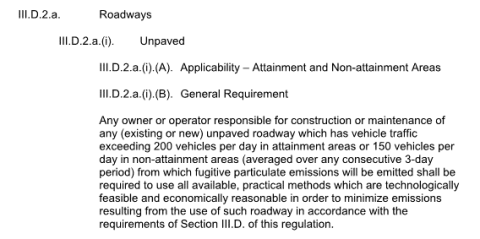
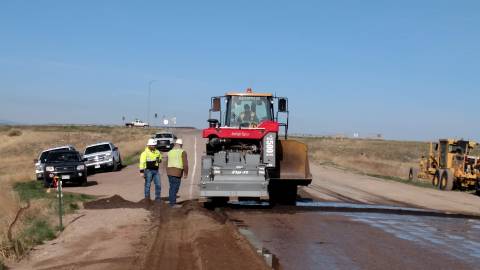
In order to protect the public's investment in gravel surfacing, gravel roads are treated with a liquid dust suppressant. Native surfaced roads that have traffic in excess of 200 ADT are also treated with dust suppressant. Colorado Department of Public Health and Environment (CDPHE) Regulation No. 1 requires Larimer County to control fugitive dust on all non-paved roads with traffic in excess of 200 ADT.
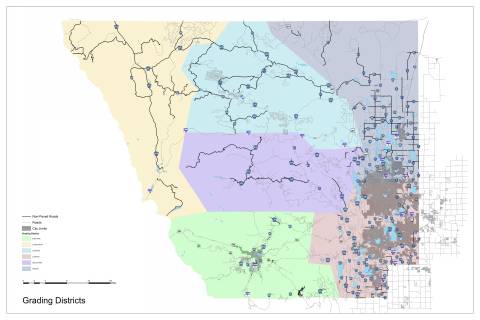
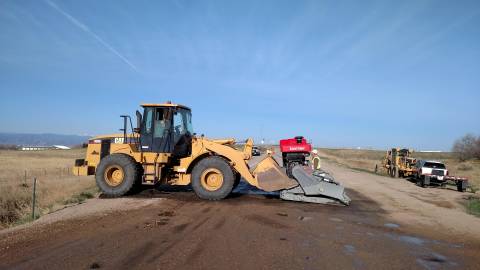
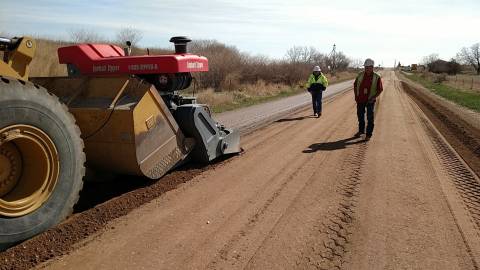
The County is divided into seven districts and each district has a grading team assigned to maintain the non-paved roads within their district. District responsibilities range from 40 miles to 150 miles of road. A grading crew is generally comprised of 3 full-time employees and a seasonal laborer utilizing 2 motor graders, a water truck and a roller.