Waste Management & Diversion: Project Updates

Planning for the Future: North Front Range Regional Wasteshed

After an exhaustive evaluation of all of the County’s different options upon the landfill closure, the following new facilities were selected as a part of an integrated approach for waste diversion of solid waste in our region following a Reduce, Reuse, Recycle & Compost model.   

New Facilities

  • Build a New Sanitary Landfill 
    The modern, sanitary, innovative landfill is under construction on a section of County-owned land in northern Larimer County at 15669 N County Rd 9,  Wellington, CO 80549 (near the Rawhide Energy Station and west of I-25) and will predominantly accept trash from the Central Transfer Station and commercial haulers. This facility will have limited accessibility to the general public and will be 100% county-owned.
  • Build a New Central Diversion and Transfer Station 
    Convenient resource recovery facility for both residents and trash haulers in separate traffic lines. The transfer station will send materials to the appropriate facilities. This facility is planned to be under construction from February 2025 through April 2026 with intentions to open soon afterwards.
  • Build a New Construction & Demolition Waste Processing Facility 
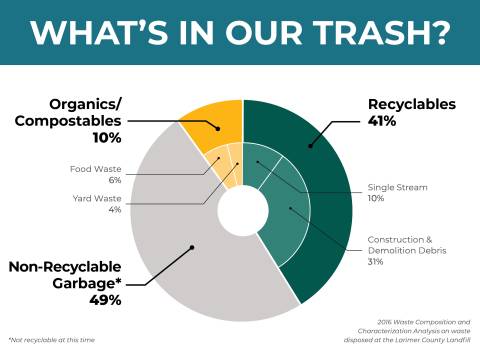
    A covered facility that sorts out mixed loads of materials from building sites (such as wood, metal, and concrete, etc.) for beneficial reuse/recycling. This facility could divert approximately 120,000 tons - about 30% of our total waste - from the landfill.
  • Build a New Yard Waste Composting System
    A windrow composting system that turns yard trimmings, such as leaves, branches, and grass, into compost, is a valuable soil amendment. This facility could divert approximately 15,000 tons from the landfill.
  • Build a New Food Waste Composting System
    An enclosed composting system that turns food scraps into a valuable soil amendment (compost). This facility could divert approximately 25,000 tons from the landfill.
  • Upgrade our current Recycling Center 
    Improve our ability to handle current and future volumes of mixed curbside recycling.

Our Next Steps

Construction & Demolition Waste Processing
  1. Larimer County is working policy and ordinance for Construction & Demolition waste materials
  2. Larimer County is exploring viable end-market users for these materials
Yard Waste Composting
Food Waste Composting
  • The Food Waste conceptual design, planning, reviews, and approvals are pending for  2023-2026

Dates are subject to change.

Information Updated:  6/15/2026
After extensive analysis, a Solid Waste Infrastructure Master Plan was developed in 2018 to lay the path for responsibly addressing current and future solid waste management in the region. The planning process included an in-depth analysis of current and future solid waste volumes, emerging technologies for waste diversion, economic and market impacts, and potential policies to support new facilities. Development of the plan relied heavily on the engagement of local stakeholder groups.


What's in our Trash

The following new facility projects were identified and selected as a part of an integrated approach for management of the solid waste in our region:   

  • New Central Landfill Transfer Station
  • New County Owned Environmentally Safe Landfill
  • Construction & Demolition Waste Processing Facility
  • Yard and Food Waste Composting System
  • Recycling Center Upgrades


Larimer County has been anticipating the need for a new system to handle solid waste since the final landfill expansion in 2004, and has saved $50 million to go towards the new facilities – meaning this project won’t have to rely on resident tax dollars.

Rather, the facilities will be built using the funds saved by the County. The operation of the facilities will rely on a sustainable volume of materials sent to each. In order to guarantee the facilities receive the volumes necessary to maintain operational costs, an Intergovernmental Agreement has been developed to guide the programs and policies implemented for each Coalition member.

The proposed Solid Waste Infrastructure Master Plan calls for new policies and programs to be adopted by Larimer County and the surrounding municipalities. These policies will help send the appropriate materials to the proposed County-owned facilities and help ensure that they are financially viable.

Participating towns and cities would have the ability to develop programs and policies appropriate for their community to encourage yard trimmings and food scraps recycling at local private and public facilities. No new rules are proposed for how or where trash is disposed. These policies may include:

  • Flow Control for Construction and Demolition Waste (C&D)
    All mixed loads of construction and demolition debris must be sent to a County-owned processing facility for a period of ten years.
  • Flow Control for Single-Stream Recyclables
    Mixed curbside recycling must be sent to a County-owned recycling center.
  • Yard Trimmings and Food Scraps Diversion
    Municipalities would be able to develop policies and programs appropriate for their community to divert organic waste from landfills.

Cost impacts to existing trash collection services are expected to be small. Waste haulers set their own rates for collection services and will adjust their pricing as needed in response to new policies and programs. Disposal costs are only a small part of the costs to haul waste materials, therefore research indicates an average monthly cost increase of less than 10% for trash collection service.

The Plan supports community goals of sustainability - with potential to divert up to 41% of the current materials going to the landfill. The diversion of waste means that these materials can be re-used and we will not be filling the landfill as quickly, giving it a much longer lifespan. 

Implementation of this Plan would make us the first to take such strides towards meeting Colorado state goals of waste diversion and reduction.


FAQs

  1. How does this change my day-to-day life?

    The new system for solid waste management/diversion is not expected to have any noticeable impacts to your day-to-day life! Maintaining your cost and convenience as much as possible has been a critical factor to the selection of a new solid waste management system.

  2. How will this affect my trash bill?

    Cost impacts to existing trash collection services are expected to be small. Waste haulers set their own rates for collection services and will adjust their pricing as needed in response to new policies and programs. Disposal costs are only a small part of the costs to haul waste materials, as an example, the City of Loveland increased the disposal cost to an estimated amount in their collection model which resulted in an average monthly cost increase of less than 10% for trash collection service.

    The reality is that the completion of the landfill will cause a change in disposal rates with or without the construction of new options. We have thoroughly evaluated many different options to ensure that the new system minimizes economic impacts while still adhering to environmental and social sustainability.

    For residents of Loveland, collection is provided by the City and therefore cost trends are expected to stay consistent with previous years. Maintaining your cost and convenience has been a critical factor to the selection of a new solid waste management system.

  3. Would the County use tax dollars?

    No! Larimer County has been anticipating the need for a new system to handle solid waste since the final landfill expansion in 2004, and has saved $40 million to go towards the new facilities.

  4. What will happen to my recyclables?

    With the change in global recycling market has come a shift in how we handle the materials. However, this shift has been met by a development in our domestic markets for recyclables. Recycling is still a very important practice! It is important to continue recycling so that as these markets continue to develop, we are able to divert the appropriate materials accordingly.

  5. Will I still be able to bring my own materials for disposal?

    Yes! You will still be able to self-haul to the transfer station (which will be at the current location of the Larimer County landfill on S Taft Hill Road), which will then send your materials to the new landfill. Existing residential convenience centers (Berthoud, Wellington, Red Feather, and Estes Park) will also still operate as usual.

  6. What is flow control and how will it affect things?

    Flow-control is a requirement that all recyclable materials of a certain type be sent to a specific location. It helps ensure adequate amounts of materials are supplied to keep facilities running effectively and efficiently.

    No new rules are proposed for how or where trash or yard waste is disposed.

  7. How could this plan impact haulers?

    Haulers will be positively impacted by the County landfill, which maintains a competitive market for landfills in northern Colorado. New policies are likely to impact haulers by changing the status quo for doing business. Communities will work with haulers to ensure new policy development and address their perspectives and needs. One primary change, flow control, will apply to mixed loads of Construction & Demolition waste (C&D) and single-stream recyclables.

    Though new facilities could impact their tipping fees for these materials, disposal costs are only a small part of the costs to haul waste materials (they also have overhead, administrative, truck purchase and maintenance, salaries and other costs aside from the disposal at the landfill or other facility). Waste haulers set their own rates for collection services and will adjust their pricing as needed in response to new rates and rules.

    This plan has been developed with the perspectives of all sizes and types of haulers as an important factor.

  8. What would happen if this plan doesn’t move forward?

    If the Solid Waste Infrastructure Master Plan does not move forward, the landfill will still close in 2024 but our region will not have a plan in place for the handling of solid waste. Rather, we will be forced to look outside of County lines for a landfill, which will lead to an increase in cost. We would no longer be in control of our fees or have facilities to recycle or compost.

  9. How rare is this opportunity?

    An opportunity to completely reset our system for solid waste management and diversion without requiring additional funds is incredibly unique and unprecedented in Colorado. As a region, we are incredibly fortunate to be in the position we are in, and for the ability to create our future of waste for the management and diversion of solid waste in our region.

Click a photo to enlarge.