Internal Climate Action, Resilience, and Education Plan (ICARE)
Larimer County is committed to environmental sustainability that reflects the community’s strong values while balancing economic and social considerations. As a governmental body, we play a unique role in building mitigation, adaptation, and overall sustainability capacity by leading through our internal operations and programs.
This Internal Climate and Sustainability Action Plan aligns with the impacts facing our region and the county’s guiding principles of responsible stewardship of public resources, innovation, adaptability, continuous improvement, and collaborative partnerships that empower individuals to take action.
The county's internal ICARE Plan was adopted in 2022 and currently involves collaboration among 16 county departments. It provides goals to address the priority focus areas in the tabs below and the actions strive to reach the desired outcomes within four areas.
GOAL STATUS Goal statuses are categorized by on track, emerging, and needs attention. The aim is to understand if efforts are proceeding as planned, are emerging with progress showing or need attention or resources to complete.
On Track
Emerging
Needs Attention
Unifying Solutions
Needs Attention
Implement all Climate, Environmental Stewardship, and Sustainability Policy areas by 2030.
Increase awareness of this Policy and update other County policies to align as needed.
Emerging
Fund greater than 90% of all high priority projects ranked by ICARE annually.
Develop and evaluate potential projects, via the sustainability matrix, annually.
Needs Attention
By 2035 see a 10% reduction in the average ozone level measured at Larimer County monitoring stations.
Continue sharing data from the new monitoring sites for evaluation in an ongoing study to understand ozone formation in Colorado's Denver Metro/North Front Range Nonattainment Area.
Built Environment, Circular Economy, Businesses & Jobs
Emerging
Reduce County facility Greenhouse Gas emissions by 62% by 2030.
We are continuously working toward building energy efficiency improvements and installation of renewable energy sources.
Integrate SolarAPP into comprehensive Community Development permitting software update.
On Track
Expand regional EV infrastructure by installing 5 charging stations on county property or through strategic community partnerships by 2030.
Continue to access priority locations for charging stations on county property and work with departments interested in adding an electric vehicle to their fleet.
On Track
The Ranch will transition handheld and walk-behind landscaping equipment to battery power by 2026, and prioritize electric options for larger mowers moving forward.
Maintain 100% electric operations for handheld and walk-behind equipment
Strive to replace larger field mowers with electric as they become available on the market.
On Track
Methane released from the landfill will be reduced 18% by 2026.
Increase the capture of current landfill gas emissions.
Update the existing Waste Characterization Study to analyze the C&D waste stream and identify landfill diversion opportunities.
Emerging
Departments and offices will expand dollars spent on sustainable operating and office supplies to 30% by 2030 and increase the number of Request for Proposals (RFPs) utilizing sustainable criteria annually.
Working closely with Amazon and Office Depot representatives to encourage employees to buy sustainable products.
Offering sustainable evaluation criteria to be included on County issued RFPs.
Mobility of People, Goods & Services
On Track
Increase the miles of regional paved trails in unincorporated Larimer County 30% by 2043 and widened shoulders by 20% by 2030 in Larimer County.
Implement bike lanes or widen shoulders as part of roadway improvement projects
Partner, as feasible, on key priority regional trail connections with other agencies
Emerging
Increase average miles per gallon of County light-duty fleet by 20%.
Create awareness campaigns regarding emission reduction benefits from increased fuel economy and alternative fuels.
Transition light-duty fleet vehicles to alternative fuel use 1.5% each year.
Emerging
The Ranch will reduce emissions from on-campus transportation and improve accessibility.
Replace gasoline-powered utility vehicles with electric carts and e-bikes where operationally feasible.
Evaluate opportunities to improve pedestrian and bicycle connectivity throughout campus, reducing the need for vehicles to travel between facilities. Also makes it safer for their patrons.
Install additional electric vehicle charging infrastructure as future demand and campus development require.
Emerging
By 2030, increase the percentage of employees who use an alternative commute mode two or more days per week to 15%.
Continue incentivizing employees to use alternative modes of transportation through workplace challenges and gamification
Install secure, weather-protected bike shelters at priority locations as funding is available
Natural Environment, Water & Agriculture
On Track
Reduce average annual irrigation water 20% by 2027
Implement the Landscape Water Reduction Plan by replacing turf, retrofitting sprinklers, planting native vegetation, and other restoration work at buildings facilities manages.
On Track
Ensure that no more than a total of 5% of any county open space acreage is converted out of native vegetation (via infrastructure, parking, trails, croplands, etc.), to ensure protection of existing intact native habitat, biodiversity and carbon sequestration.
Complete key projects that restore acres of non-native vegetation
On Track
Conserve 74,000 acres of open space within Larimer County to protect ecological, scenic, community separator and agricultural values, by 2043.
Implement strategic acquisition efforts per current Open Lands Master Plan priority conservation areas.
Update Open Space Master Plan to include climate and resilient ecosystem service considerations (by 2027)
On Track
Each year, conduct at least 10 emergency preparedness classes and attend at least 10 community events at every designated Larimer Connects Hub location
Establish a consistent rotating calendar of classes through the community hubs each calendar year.
The 'E' in ICARE stands for Employee Education. Larimer County has an Employee Sustainability Awareness Team striving to provide education to employees around a variety of environmental steps we can take in our workplace.
This team plans events for employees like biking and carpooling challenges, electronic battery waste drives, and provides education through webinars, newsletters, and flyers.
A Few Key Accomplishments
2022
Paper reduction countywide such as eliminating all paper bid & proposal submissions
Completed an Internal Greenhouse Gas Inventory
2023
EV Charging Station Roadmap developed
Landscape Water Reduction Plan completed and projects ongoing
Updated County Facility Design Criteria to include alternative energy source evaluation for all new facilities
Expanded access to nutritious food and offered extension nutrition classes for county residents
Offered free produce to income-qualified seniors through Market Days for Older Adults and increased number of produce bags delivered to seniors
Provided public health data around poor health quality and health outcomes
Anti-Idling campaign launched
Developed a guaranteed ride home program for employees who use alternative transportation for commuting
Started green purchasing programs with Amazon and Office Depot
2024
Received silver Solsmart designation
Recognized at the silver level by the Colorado Green Business Network for two buildings
72 miles of widened shoulders have been added to County roads to improve bicycle access, to date
Removed one County building from the 500-year floodplain
Two regulatory ozone monitors added to the regional network
Larimer County Department of Natural Resources (LCDNR) converted 19 pieces of equipment to electric using a Colorado Regional Air Quality Council grant
Fleet acquired 2 electric vehicles
Commercial Landscaping Electrification Grant program piloted with 14 businesses awarded
Four new Larimer Connects community hubs were established by Office of Emergency Management, making the total 21 in the County.
2025
Installed 1 DCFC and 4 L2 stations making 6 stations total available to the public
Natural Resource invasive annual grass management project implemented on over 2,800 acres allowing the soils to capture more carbon
Completed our first employee commuting survey to serve as a baseline for alternative transportation initiatives
The Solid Waste Department was awarded a grant to expand the landfill's methane collection system
Fleet acquired 3 additional electric vehicles (6 total)
Three water reduction projects complete consisting of turf reduction, native species plantings, and irrigation retrofits to drip systems
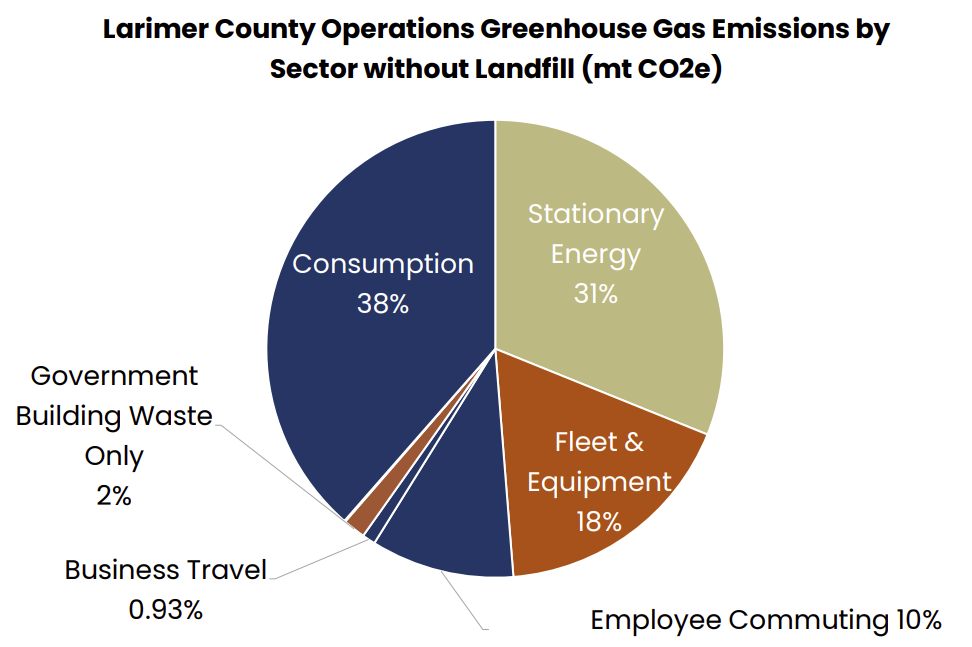
As a part of the ICARE Plan, Larimer County recently embarked on an update to its local government operations greenhouse gas (GHG) emissions inventory. More detailed information about the results including landfill emissions can be found in this memo.
A GHG inventory, also known as a carbon footprint assessment, is a quantified list of an organization’s greenhouse gas emissions and emission sources. Greenhouse gas inventories can serve as baselines to track increases and decreases in future emissions and can help identify reduction targets and effective strategies for reducing emissions within our operations.
A briefing the Larimer County Commissioners received is available as slides or a recording.
Larimer County has been hard at work being good stewards of our resources, economy, and community in a sustainable manner since 1975. We hope you enjoy this trip down memory lane!
 The 'E' in ICARE stands for Employee Education. Larimer County has an Employee Sustainability Awareness Team striving to